
Trascar has been working alongside large-scale retailers and the food industry for years, developing standard “Goods-to-Person” solutions that address both companies’ immediate operational needs and their strategic objectives. Logistics is thus reimagined as a competitive advantage, not just a cost.
When we talk about large-scale retail, we immediately think of stores— —with full shelves and the variety of products that reach millions of consumers every day. But behind this apparent simplicity lies a much more complex world: that of logistics. And it is precisely in this world—made up of processes, temperatures that must be maintained, and flows that must be optimized—that companies like Trascar have begun to play a decisive role, offering solutions that transform the “behind-the-scenes” operations of large-scale retail into a true competitive advantage.
Logistics in the Italian large-scale retail sector is an ecosystem rich in interdependent operations: goods arrivals, quality controls, storage, order fulfillment, vehicle loading, and distribution to retail locations.
A system that must operate every day, without interruption, handling enormous volumes and a unique variety of products.
Large-scale retailers are forced to seek efficiency everywhere: reducing picking errors, maintaining the cold chain, improving the traceability of expiration dates, and optimizing warehouse space.
This is where process digitization and automation are no longer options, but necessities.
And it is precisely in response to these needs that Trascar has developed GTP (Goods-to-Person) solutions and technologies such as those in the Wonder_pick family, designed to adapt to the workflows of large-scale retail and increase productivity.
The Challenge of the Three Temperature Zones: Ambient, Chilled, and Frozen
The real logistical test for large-scale retail, however, is the simultaneous management of three temperature ranges: ambient, chilled, and frozen. Each range has its own constraints, costs, and challenges.
Maintaining the Cold Chain
The transfer of products from one environment to another, the time cold storage units are left open, and handling in refrigerated aisles: every detail can affect product quality.
And if something goes wrong, waste and non-compliance issues multiply.
Picking in Cold Storage Areas: A Human Limitation
Operators working in cold storage or frozen food areas have shorter working times, tire more easily, and are more prone to making mistakes. This naturally increases labor costs and makes it harder to maintain high production rates.
Different spaces, different needs
Logistics are needed that can simultaneously handle: high storage density,
fast picking, significantly varying turnover rates between product categories, and the tracking of expiration dates and FEFO/batch management.
This complexity calls for solutions specifically designed for this sector.
The result is a logistics system that is more responsive, more organized, and above all, more predictable—essential qualities when handling fresh and perishable products.
Trascar GTP for Large-Scale Retail: A Paradigm Shift
With the Goods-to-Person approach, it is no longer the operator who moves around the warehouse searching for goods—it is the goods that come to the operator. This means: less time spent in cold storage, faster picking, greater order accuracy, optimized warehouse space, and a safer, more comfortable work environment.
The Wonder_pick family and Trascar’s other GTP solutions were developed specifically to address the challenges typical of large-scale retail.
Not a “generic” system, but a modular set of technologies that adapt to the company’s workflows, supporting activities such as:
- high-density storage,
- picking in a controlled environment,
- order buffering and sequencing,
- integration with WMS and FEFO logic,
- multi-temperature management with harmonized processes.
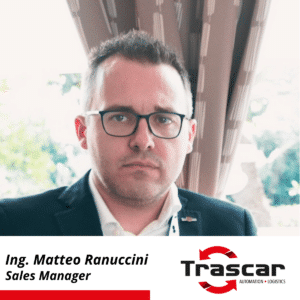 “The large-scale retail sector is undergoing a historic phase in which margins and shelf space are shrinking, while consumer expectations are rising. Companies that optimize their logistics achieve tangible benefits, such as reduced waste, more stable performance during peak periods, improved service levels at retail locations, a resulting reduction in operating costs, the ability to manage more SKUs in less space, and greater energy sustainability. It is precisely our ability to offer standard yet flexible solutions—highly automated and perfectly integrable into existing processes—that makes us the partner capable of transforming a large-scale retail warehouse into an efficient, modern, and future-oriented hub.”
Concludes Matteo Ranuccini, Sales Manager at Trascar.